
Cricket X RTP Explained
Cricket X is a crash-style game, so RTP should be treated as a broad mathematical concept rather than a promise for any single round. What matters in practice is how volatility, session length, cash-out timing, and bet sizing shape real play.
This guide explains what RTP means in Cricket X, what it does not mean, and how players can use it as a reference point without turning it into a false expectation. The goal is not to chase certainty, but to understand how the game behaves over time.
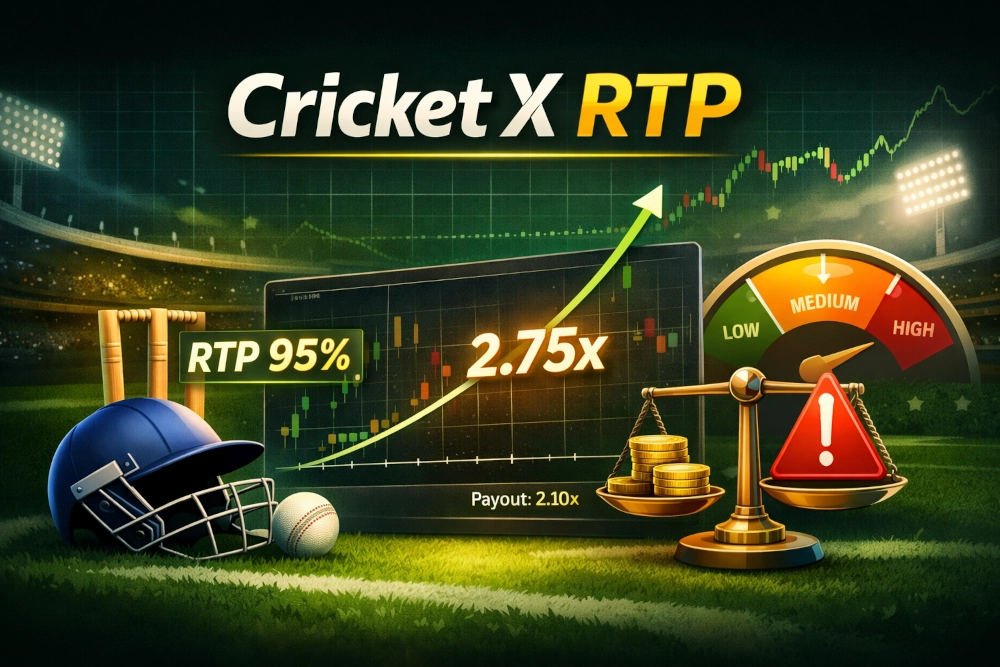
Long-term return model
RTP stands for Return to Player. It describes the theoretical percentage of wagered money that may be returned over a very large number of rounds.
Not a short-session guarantee
It does not guarantee that a short session, a day of play, or a single bet sequence will follow that percentage. Real outcomes can move far above or below it.
Useful for context
RTP is still useful because it helps compare games, understand risk structure, and avoid unrealistic assumptions about “best moments” or “guaranteed returns”.
How RTP works in a crash-style game
In Cricket X, the multiplier rises until the round ends. The player decides when to cash out, and that decision creates the core tension of the game. Because players can leave at different points, actual experience depends not only on the mathematical design of the game but also on player behaviour.
That is why RTP in a crash-style title feels different from RTP in a traditional slot. A slot spin is resolved automatically. In Cricket X, timing plays a visible role, which can make the game feel more controllable even though risk is still very real.
Main factors that shape real results
- Chosen cash-out point and whether the player exits early or stays longer
- Bet size relative to bankroll and how much pressure each round creates
- Session length and exposure to more high-variance sequences
- Emotional decisions after misses, especially after near cash-out moments
- Whether the player sticks to a fixed plan or changes targets mid-session
RTP vs volatility in Cricket X
RTP and volatility are related, but they are not the same thing. RTP describes the theoretical return over time. Volatility describes how sharply outcomes can swing on the path toward that long-term number.
A volatile crash game may still have a solid theoretical return, but players can still go through uneven sessions with fast exits, missed cash-outs, and emotionally difficult sequences.
Why volatility matters more in short sessions
Most players do not play thousands of rounds in one sitting. They play a short session. In that window, volatility often has a bigger practical effect than RTP because swings are felt immediately.
That is why disciplined timing, realistic expectations, and firm stop points matter more than trying to “beat” the theoretical return.
Reading RTP as a promise
Some players see an RTP number and assume that losses should soon reverse. That is not how it works. RTP is not a refund cycle and not an indication that the next few rounds are “due”.
In a crash game, that misunderstanding can be even stronger because the live multiplier creates a sense of timing and anticipation.
Use RTP as a framework
The more useful approach is to treat RTP as background information. It helps you understand the structure of the game, but it should never replace bankroll control, session planning, and calm cash-out decisions.
How to use RTP information in a practical way
Good questions to ask before playing
- Am I using a cash-out plan or just reacting live?
- Can my bankroll handle short losing runs without panic?
- Am I trying to recover, or am I following a limit-based session?
- Would a demo session help me understand rhythm before staking real money?
Should you choose a game based only on RTP?
No. RTP can be a useful signal, but it should not be the only decision factor. In games like Cricket X, play experience depends heavily on pacing, player timing, emotional discipline, and bankroll structure.
A better method is to combine RTP awareness with a review mindset: understand the game logic, try the demo version, study the volatility feel, and only then decide whether the format matches your style of play.
Frequently Asked Questions
What does RTP mean in Cricket X?
RTP means Return to Player. It reflects a theoretical long-term return model, not a guaranteed outcome for a single round or short session.
Does a higher RTP mean I will win more today?
No. A short session can perform very differently from the long-term theoretical number. Volatility and player timing can have a major effect on immediate outcomes.
Is Cricket X RTP the same as slot RTP?
The concept is similar, but the experience feels different because Cricket X is a crash-style game where the player chooses when to cash out.
Can RTP help me build a better strategy?
It can help as background context, but practical strategy still depends more on bankroll limits, cash-out discipline, session control, and responsible play.
Use RTP as context, not as a shortcut
Cricket X becomes easier to understand when RTP, volatility, and session control are viewed together. That combination gives players a more realistic picture of risk than any single number on its own.